
News Byte – 09.07.2026

By Byte & Block — exploring the building blocks of digital finance.
Today’s Menu
- Interpol maps scam crypto rails
- Revolut narrows USDT exit scope
- Bitcoin ETF flows wobble again

Interpol’s $122M Scam Wallet Shows the Laundering Stack
Interpol’s latest fraud sweep makes the usual “crypto scam” headline more concrete. Investigators traced a suspected romance-scam laundering wallet that processed more than $122.5 million in just 10 months.

Thai authorities arrested two suspects and said the network pushed proceeds from romance scams into crypto, then used cross-chain token swaps to make the trail harder to follow. The wider operation ran across 97 countries and territories, with 5,811 arrests, $293 million in intercepted illicit assets, 31,014 blocked bank accounts and 15,606 identified suspects.
That scale is the point. This is not one suspicious wallet drifting through a block explorer. It is law enforcement mapping the payment plumbing behind social-engineering fraud, from bank accounts to virtual wallets to the cross-chain hops that make recovery harder.
The common thread with the MEV bot drain we covered in June is incentive design: automated crypto rails don’t create fraud by themselves, but they can make bad incentives move very quickly.
The uncomfortable read is that crypto is not only where some stolen money ends up. It can become part of the laundering stack after victims have already been manipulated. That makes the enforcement story less about blaming the rails and more about watching where the rails get abused.

Revolut’s USDT Exit Is Regional, Not Global

Revolut’s USDT delisting is narrower than the first wave of headlines made it sound.
The company says the change affects customers in the European Economic Area and Switzerland, while USDT support continues in other markets. That is the real story: not a global Revolut exit from Tether, but a regional product split shaped by MiCA and the company’s own risk review.
The blunt market read still matters, because Revolut joins other platforms removing non-approved stablecoins from parts of Europe.
That fragmentation lands on top of the same stablecoin payment plumbing that made dollar tokens useful in the first place.
Switzerland is the odd wrinkle. Revolut included Swiss customers even though Switzerland is not in the EU or EEA and is not directly covered by MiCA. That makes the scope question more interesting than the delisting headline itself. It also shows how compliance teams often draw operational lines that are broader than the statute everyone is arguing about.
So the clean framing is not “Revolut dumps USDT.” It is: same app, same token, different access depending on jurisdiction. Europe’s stablecoin rulebook is turning compliance into a product map, and users are the ones who notice when the map changes under their feet.

Bitcoin ETF Flows Stop Bleeding, But Conviction Is Still Thin
Bitcoin ETF flows have stopped bleeding in a straight line, but the recovery signal still looks soft.
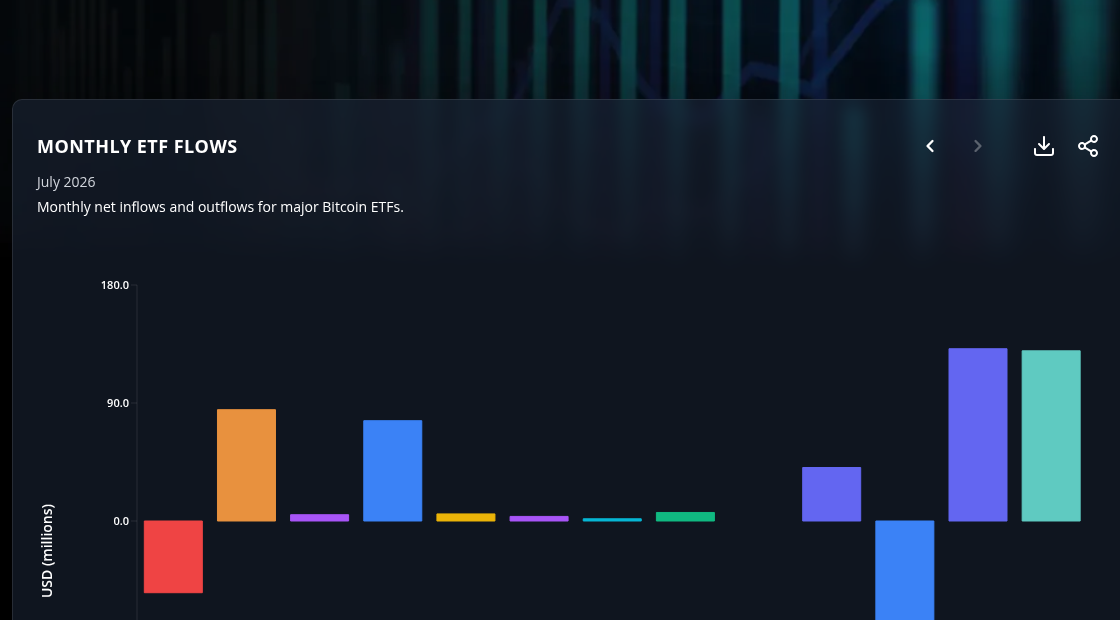
US spot Bitcoin ETFs saw 10 straight days of net outflows totaling $2.7 billion from June 17. The group then flipped to more than $500 million of net inflows over three trading days before sliding back into an $84.9 million net outflow on Wednesday.
That is not a clean bullish reversal. It is a market trying to decide whether ETF demand is returning or simply pausing after forced selling pressure eased. Swissblock’s framing catches the mood well: the storm may have passed, but accumulation is still not strong enough to call conviction fully back.
That is why ETF flows remain one of the cleaner demand gauges: they show when the wrapper is absorbing supply, and when it is giving it back.
The bigger tell is the split between spot and derivatives demand. Futures positioning has recovered faster, while spot buyers remain more cautious. That matters because durable Bitcoin rallies usually need both sides moving together, not just leveraged traders leaning into a rebound.
For now, the ETF wrapper still matters. It just no longer guarantees one-way demand. Bitcoin has to earn flows again, and every redemption streak now reads like a real institutional temperature check.
Meme of the day

Follow @byte_and_block for bite-sized insights, or subscribe to the newsletter for deeper dives.
If this helped you cut through the noise, join hundreds of readers who get Byte & Block in their inbox every morning
Subscribe to our newsletter!