

 Telegram Bot
 What ETF Flows Really Tell Us About Bitcoin Demand (Explained Simply)

A Byte & Block deep dive into the new X-ray for Bitcoin demand.
Bitcoin Finally Has a Mirror
For most of Bitcoin’s history, trying to measure “real demand” was guesswork with better branding.
You had on-chain flows, exchange balances, Twitter sentiment, Google Trends, miner behavior, whale alerts… it was a jungle of signals, none of them comprehensive, all of them noisy.
Then something changed.
Spot Bitcoin ETFs arrived in the U.S., and suddenly the market had something it never had before:
A clean, regulated, auditable stream of demand data — in daylight.
ETF flows turned Bitcoin into something closer to a traditional asset.
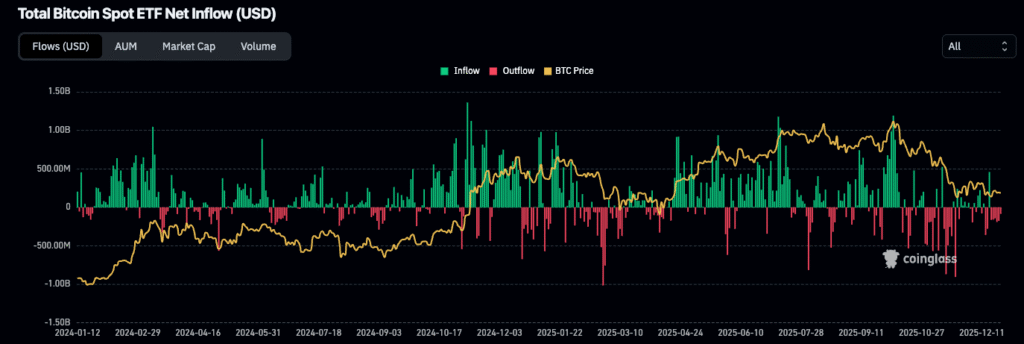
When money enters an ETF, BTC must be bought.
When money leaves, BTC must be sold.
For the first time, Bitcoin has a mirror — and it doesn’t blink.
What ETF Flows 📊 Actually Measure (Explained Simply)
Let’s kill the confusion upfront.
An ETF flow isn’t a vibe, a prediction, or a chart pattern. It’s a transactional fact.
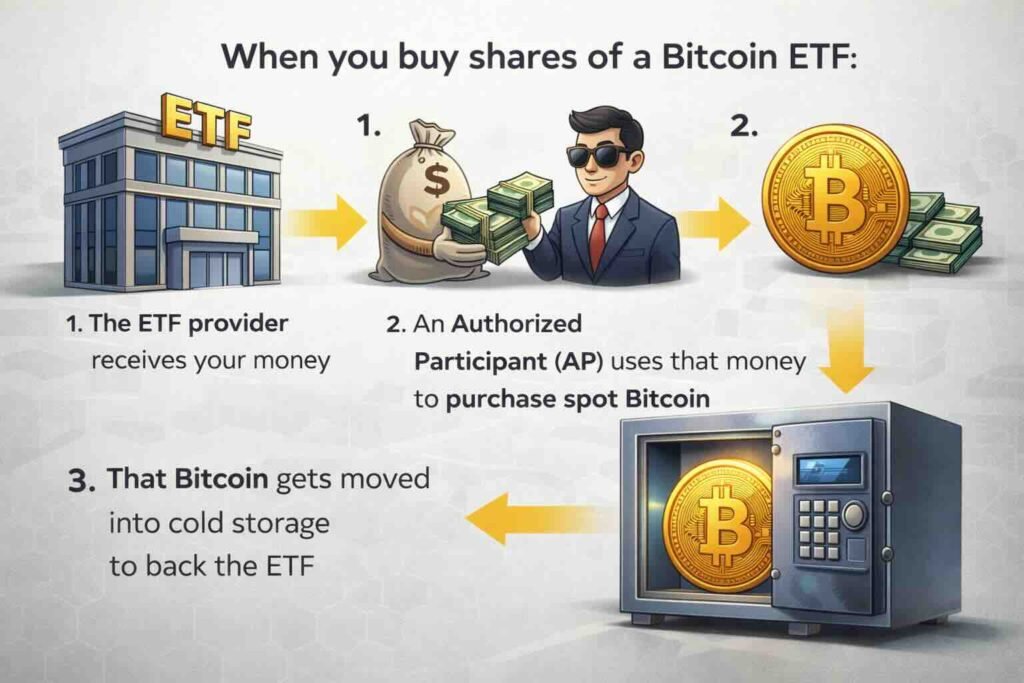
When you buy shares of a Bitcoin ETF:
- The ETF provider receives your money
- An Authorized Participant (AP) uses that money to purchase spot Bitcoin
- That Bitcoin gets moved into cold storage to back the ETF
This is not leverage.
This is not derivatives.
This is not “paper Bitcoin.”
This is spot BTC demand, enforced by regulation.
If $200 million flows into ETFs, roughly $200 million of Bitcoin gets bought.
If $200 million flows out, Bitcoin gets sold.
There’s no room for hopium here — flows tell the truth.
Why ETF Flows Became Bitcoin’s Strongest Demand Signal 📈
Before ETFs, analysts relied on proxies:
• Exchange volumes (distorted by wash trading)
• On-chain activity (hard to interpret without intent)
• Derivatives funding rates (gambling energy)
• Whale wallet movements (mysterious as always)
ETF flows solved the ambiguity.
They are:
• Regulated
• Transparent
• Non-leveraged
• Institutional-grade
• Directly tied to spot buying
This is why ETF flows moved to the top of the market’s priority list.
They show real world appetite — from pensions, RIAs, asset managers, brokerage accounts, financial advisors, insurance portfolios, and retail investors who don’t want crypto wallets.
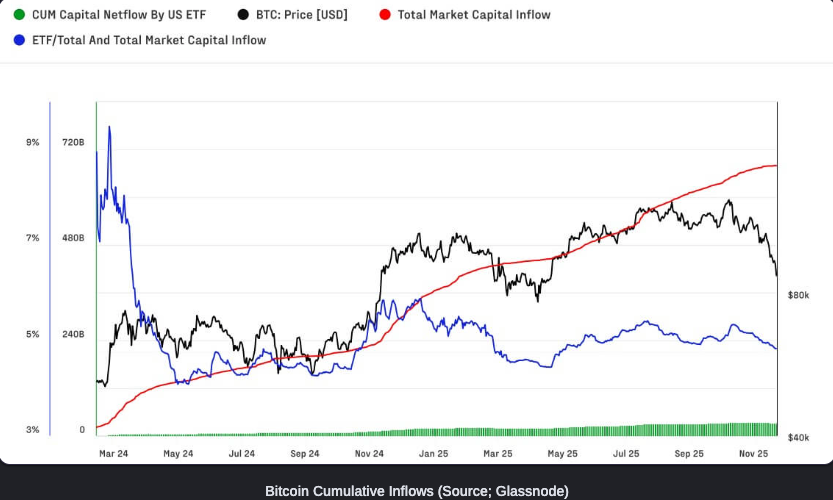
ETF flows are Bitcoin demand wearing a name tag.
How to Read Inflows ➡️ and ⬅️ Outflows Without Overthinking It
Now that we know ETF flows matter, let’s decode what they mean.
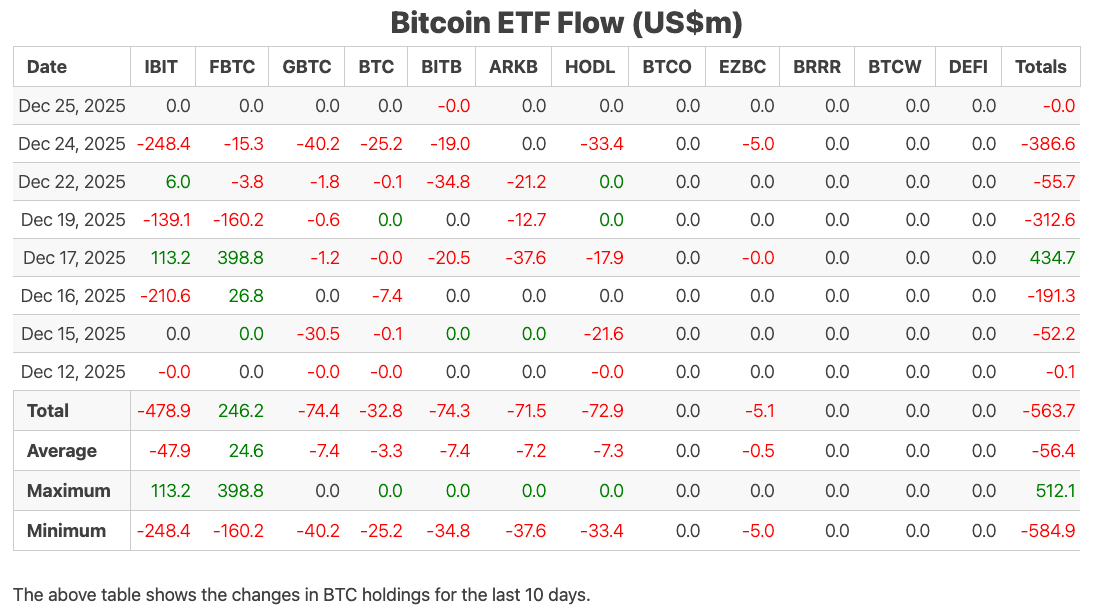
Positive inflow
✔ New demand
✔ Institutions buying
✔ Structural accumulation
✔ Price support
Zero inflow
⚠ Lack of conviction
⚠ Market waiting
⚠ Narratives cooling
These “flat days” are actually the most important, because they often precede big trend pivots.
Outflow
❌ Sell pressure
❌ De-risking
❌ Profit-taking
❌ Macro fear
But here’s the nuance:
An outflow doesn’t mean “everyone is bearish.”
It means one category of investor is reducing exposure.
This is not ideological — it’s economic.
Builders care about cost curves, not slogans.
And decentralized storage is winning on cost.
The Silent Indicator 🤫: ETF Market Share (Who’s Buying Matters)
Not all ETF flows are created equal.
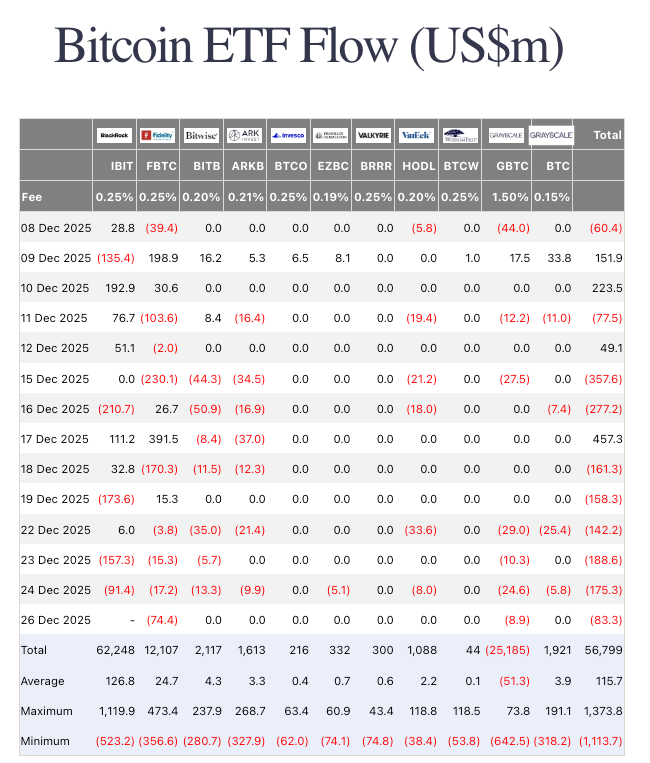
If BlackRock and Fidelity dominate inflows, it tells you:
• Advisors are allocating
• RIAs are onboarding
• Institutional pipelines are opening
If smaller ETFs bleed, it tells you:
• Retail is cautious
• Self-directed investors aren’t aping
• Liquidity is concentrating in the strongest products
This is one of the most underrated signals in the entire ETF ecosystem.
The distribution of flows tells you what type of money is moving.
What ETF Flows Don’t Tell You
Here’s where many analysts go off the rails.
ETF flows are powerful, but they are not the whole picture.
They do NOT capture:
• On-chain accumulation
• Corporate BTC purchases
• Asian flows
• OTC trades
• Miner accumulation/divestment
• Whale cold-storage behavior
• Exchange reserve changes
• Stablecoin rotation into BTC
ETF flows are a lens — not a crystal ball.
This is why ETF flows can show outflows while Bitcoin stays stable:
Off-exchange demand absorbs that selling pressure.
And the opposite happens too — ETF inflows spike, price barely moves, because sellers meet that demand instantly.
Never assume ETF flows = instant price action.
The Bigger Picture: How ETF Flows Are Reshaping ₿’s Market Structure = The New Industrial Stack
ETF flows didn’t just add transparency — they changed Bitcoin at a structural level.
Here’s how:
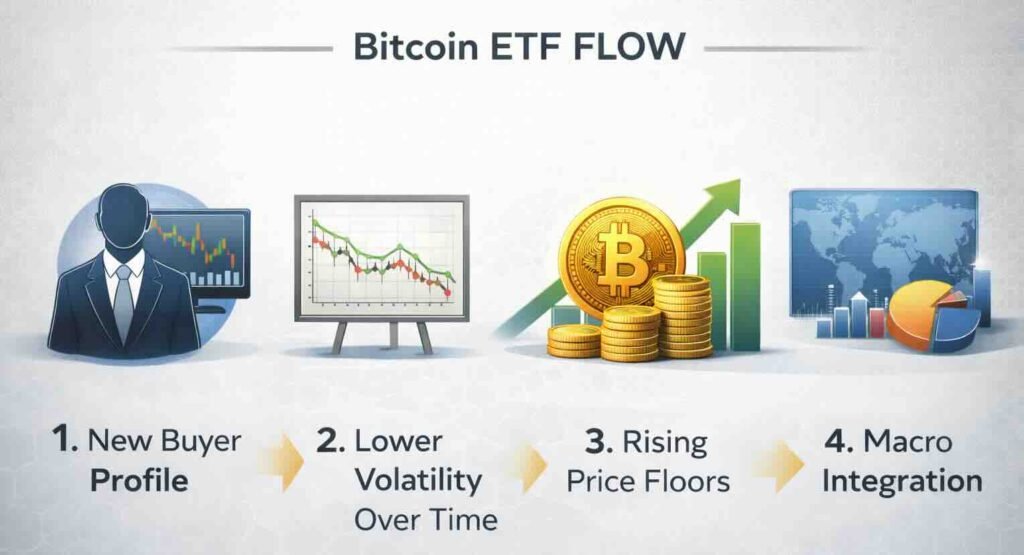
1. New Buyer Profile
Not traders.
Not degens.
Not leverage chasers.
ETFs bring in:
• pension funds
• wealth managers
• financial advisors
• long-term allocators
• corporate treasuries
These buyers don’t chase candles — they buy dips and rebalance quarterly.
2. Lower Volatility Over Time
More steady buyers → smoother price action.
3. Rising Price Floors
ETF inflows create sticky demand.
Less BTC floats on exchanges.
4. Macro Integration
ETF flows sync Bitcoin to:
• interest rates
• liquidity cycles
• capital rotation
• wealth management flows
Bitcoin is no longer an outsider — it’s plugged into the financial bloodstream.
Final Word — ETF Flows Are Bitcoin’s New X-Ray
ETF flows cut through noise.
They tell you:
• When real money is buying
• When real money is leaving
• How strong demand is
• Whether the market has conviction
• When macro conditions shift
• Which investor class is active
Bitcoin has dozens of narratives.
Hundreds of indicators.
Thousands of opinions.
But ETF flows?
They’re simple:
Money in → BTC gets bought.
Money out → BTC gets sold.
For the first time in Bitcoin’s history, demand is measurable — and that transparency is reshaping the entire market.
ETF flows aren’t hype.
They’re the signal.
And we’re still early in understanding just how powerful that signal will become.
⸻
☕️ Byte & Block out.
💬 What’s Next

Up next on Byte & Block:
- “The Tokenization Boom: How Real-World Assets Are Coming On-Chain”
Follow @byte_and_block for bite-sized insights, or subscribe to the newsletter for deeper dives.
Subscribe to our newsletter!